Forces Acting on a Skydiver 2

Displaying 1 - 1 of 1

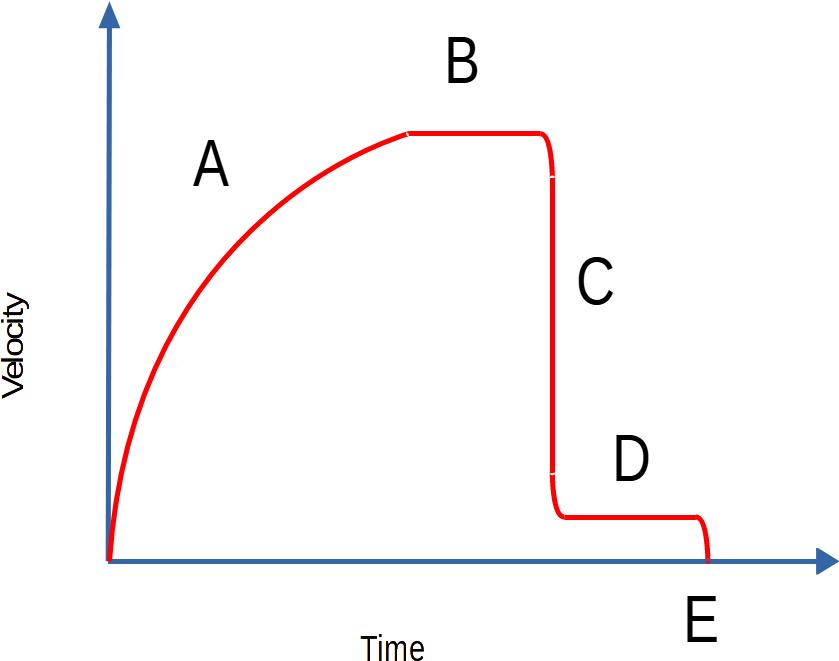
FirstFirstLastQuiz Score TotalQuestion 2aImage 2a2a) How can we tell from the graph that the skydiver is accelerating during part A?2b) Explain in terms of forces why the rate of acceleration decreases during part A?2c) The skydiver reaches a terminal velocity during part B. What is meant by terminal velocity?2d) The skydiver open their parachute at the start of part C. In terms of forces, why does the skydiver decelerate?2e) The skydiver reaches a second terminal velocity during part D. What can we say about the forces acting during part D?2f) Why is it safe for the skydiver to land during part D's terminal velocity?Quiz Percentage Grade
ppefmhEdGarstin1/4The graph below shows the velocity of the skydiver from when they leave the airplane.
  • During part A, the velocity of the skydiver is continuously increasing. This means that the skydiver is accelerating.
  • During part A, the velocity of the skydiver is continuously decreasing. This means that the skydiver is accelerating.
  • During part A, the velocity of the skydiver is continuously increasing. This means that the skydiver is decelerating.

gfdf

  • The air resistance balances the weight of the skydiver so there is no resultant force acting. This means that the skydiver's velocity is constant. This is called terminal velocity. However, during part B the terminal velocity is very large and if the skydiver tried to land they would be killed.
  • The air resistance is stronger than the weight of the skydiver so there is a resultant force acting. This means that the skydiver's velocity is accelerating. This is called terminal velocity. However, during part B the terminal velocity is very large and if the skydiver tried to land they would be ok.
  • The air resistance balances the weight of the skydiver so there is a resultant force acting. This means that the skydiver's velocity is constant. This is called acceleration.
  • Opening the parachute causes air resistance to massively increase. air resistance acts upwards so now there is an upwards force. This causes the skydiver's downward velocity to decrease. (I.E. they decelerate)
  • Opening the parachute causes air resistance to massively decrease. air resistance acts downwards so now there is an downwards force. This causes the skydiver's downward velocity to increase. (I.E. they accelerate)
  • Opening the parachute causes air resistance to massively increase. air resistance acts upwards so now there is an upwards force is balanced. This causes the skydiver's downward velocity to stay the same. (I.E. the speed is constant)

gf

  • The terminal velocity in part D is much lower than the terminal velocity in part B. This means that the skydiver can now safely land.
  • The terminal velocity in part D is much higher than the terminal velocity in part B. This means that the skydiver cannot safely land.
  • The terminal velocity in part D is the same as the terminal velocity in part B. This means that the skydiver can now safely land.
25%
FirstFirstLastQuiz Score TotalQuestion 2aImage 2a2a) How can we tell from the graph that the skydiver is accelerating during part A?2b) Explain in terms of forces why the rate of acceleration decreases during part A?2c) The skydiver reaches a terminal velocity during part B. What is meant by terminal velocity?2d) The skydiver open their parachute at the start of part C. In terms of forces, why does the skydiver decelerate?2e) The skydiver reaches a second terminal velocity during part D. What can we say about the forces acting during part D?2f) Why is it safe for the skydiver to land during part D's terminal velocity?Quiz Percentage Grade